Friday, April 6, 2018

Thing 17: Sharing Your Work

Your Task:

Option 1: If you have a Powerpoint Presentation or published paper of some kind that you can upload and share to Slideshare or ResearchGate or similar applications, give it a try! What do you think? Are you happy with the results?
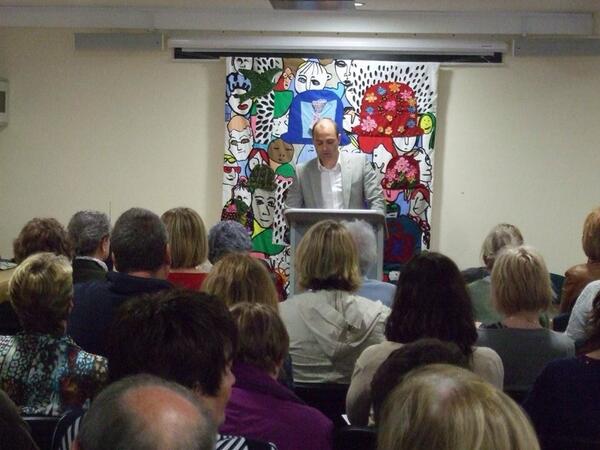
I don't have anything suitable that I can upload or share at present. But I have participated (as sidekick) in presentations to WWETB ESL tutors about library services for refugees as part of the refugee resettlement programme in Co. Wexford. My colleague who prepared the presentation has now left the service so it's likely I may have to present something like this again in the future on my own. Similarly presentations on the 'Work Matters in the Library' programme for providing and promoting library services to job-seekers and businesses were provided in the past, and will have to be repeated in the future to The Hatch Lab "a new Tech Incubator space located in Gorey ... supporting business concepts, business start-ups and co-working staff." So I will have to prepare something and will consider sharing it then. [Yikes!]

https://twitter.com/DearbhlaAine/status/877577291039203328
with in the library (21 June 2017)


Option 2: If you would like to have a presentation or publication to share, now’s the time to track down either a conference or forum or other gathering that you think you might be interested in presenting at; or some kind of publication that you think you might like to submit a piece of writing based on your work for. What is the focus of the gathering or publication? What is the audience? What looks appealing to you about the gathering / publication? And how does its focus relate to your own work?
I would like (theoretically) to present something (maybe just a poster) at the LAI Public Library Conference some year on public libraries and the Irish language. Alternatively write something for An Leabharlann. I'm too late for the joint CILIP/LAI conference 19-20 April 2018 (phew!), but maybe this should be a bucket list for 2019?
  • What is the focus of the gathering or publication? Public Libraries in Ireland
  • What is the audience? Librarians working in public libraries in Ireland
  • What looks appealing to you about the gathering / publication? It is a forum for sharing ideas / learning from colleagues working in public libraries throughout Ireland, sometimes with guest speakers / writers from abroad to give an international perspective. 
  • And how does its focus relate to your own work? Focused on library practice and research into library practice in Ireland, so it is relevant to my work as an executive librarian in Co. Wexford Public Libraries. I attended the 2017 LAI conference and found it very worthwhile.


Librarians on the roof, but not a protest
https://twitter.com/andytraining/status/847483812082626562

(#Where'sDearbhla? - hidden in plain sight - background comfort zone)

ENDS 

Wednesday, April 4, 2018

Thing 16: My Digital Footprint

Task: to run a diagnostic of how I protect myself against violations of your privacy on the internet. How do these compare with the precautions that I take? 
  • I avoid or minimise the personal information I give to websites I am unfamiliar with.
  • I do not respond to phishing emails. I only ever call my bank on a number I trust or login into my account on a trusted computer on a secure internet connection.
  • I don’t download illegal software.
  • I will be more wary of connecting to the internet via WiFi, that it is a legitimate hot-spot and is encrypted.
  • I will minimise the number of apps I download to those I really need & I will read the T&C’s of the apps I download so that I can give “informed consent”
  • I'm always aware online of what I post, from a defamatory perspective and regarding giving out too much information about me or my family.
  • I will educate myself about the basics of the internet and how it works to become more aware of the risks and how to mitigate them.
  • I have changed and improved my password and have set up my email account to require regular password changes.
  • I'm always conscious of the pictures or content I post and try to be prudent and careful about your digital footprint.
  • I have changed my default browser to duckduckgo
ENDS


Tuesday, April 3, 2018

Thing 15: Evaluating Information

Task
Option a: It's a good time to be thinking about Wikipedia, as #1lib1ref is currently running, as of January 15, through February 3. It's a great entry-point into Wikipedia editing, the focus of the event being finding secondary sources and adding them as citations in order to strengthen the reliability of Wikipedia articles. If you'd like to use this as an opportunity to try your hand at a bit of Wikipedia editing, go ahead, there is plenty of support and instructions on the 1lib1ref home page, here https://meta.wikimedia.org/wiki/The_Wikipedia_Library/1Lib1Ref
I'm too late for the #1lib1ref, which ended 3 February, might have been a chance to get help to learn how to edit Wikipedia.

So I tried Option b:
This will make use of one of the tools that can help with 1lib1ref, the Citation Hunt tool (available at https://tools.wmflabs.org/citationhunt/en?id=de1d76dd&cat=all ).

I used the Citation Hunt tool, but couldn't find a citation needed that I could supply. I have an appalling lack of interest in factual / historical / biographical reading, and poor specialist knowledge on any given subject that any of the citations threw up. So I went back to my narrow world view, back to a search of Wexford citations needed, and it was still a good while before I found anything on Wikipedia on Wexford that needed a citation that I could supply. Mo náire!! I eventually found a Wikipedia page on Ivan Yates, former Wexford TD, and a citation was needed to support the page's claim that he was born in Enniscorthy. I noticed that his autobiography "Full on: a memoir" was not listed in the references.

This reference satisfies the CRAAP test:
Currency: published in 2014
Relevance: autobiography by Ivan Yates
Authority: written by the subject of the Wikipedia page himself
Accuracy: I would assume that  the author would give an accurate account of his life and a book published by a reputable publisher Hachette Ireland should be accurate, and should have employed legal advice to avoid any libel being published.
Purpose: The purpose of the book is for Yates to provide his memoir of his life. Since the citation was needed for his place of birth (Enniscorthy), I could not see what purpose it would serve him to include false information on this point. Also it is a fact that could easily refuted by many, if an error was published.

So I tried to edit the page, to add it as a citation or a reference, but I didn't succeed. I tried the 'talk' page and the 'Ireland portal' to see if I could get some help, but no joy. 
To be honest, life is short, and in your article I can understand why it is mostly white males aged 18-30 who are editing Wikipedia. If it wasn't late at night, after a full day's work, and if I had some idea of what I was doing and a page of code didn't look like a plate of spaghetti, I might  try to spend some of my scarce free time trying to figure out how to edit Wikipedia pages too! I know it is a valuable cause, but not as valuable as my free time now. 

However, I did make a note of Dr. Rebecca O'Neill's contact details in my Evernote, making a new note on Wikipedia editing and a new notebook on Information Technology events, and I might try to organise a workshop on Wikipedia editing for adults and teens over the summer. We have a North Wexford Historical Society that meets in the library, and they are working on recording gravestones online now, so they might be interested in this sort of citizen science / citizen curator type workshop. I have another similar workshop planned for the end of April with Meitheal Logainm  - a community placename collection project https://meitheal.logainm.ie/en/for the historical society and for schools.
So I feel worse than "those who can't do, teach, and those who can't teach lecture" - I'm one of those who can do neither, but I can try to set up a workshop in the local library so someone who can do, teach and lecture, can show those who are interested! It makes me feel a little less worthless!

Q. How do you find your own evaluation skills?
A. Weak and unpracticed

Q. Does needing to find rigorous information on your own help to put yourself in the shoes of people you might be helping in your work?
A. Yes, but I am rarely asked for information sources for projects. Most of our enquiries are for books for recreational purposes - fiction and non-fiction reading for pleasure, so as long as we can find the author and title and source the book, that it often the extent of our work. 

Q. Does going through this kind of exercise make you feel better equipped to talk others through the need for a critical or evaluative approach to information -- and how one might take such an approach?
A. Yes, it helps make me aware of critically evaluating information and information sources - even if only using the simple CRAAP test.

ENDS

Monday, April 2, 2018

Thing 14: Personal Information Management

Your Tasks
1.       Set up a couple of notebooks in Evernote. Think of some projects you are or might or would like to work on. Find some online content to put into your notebook as notes, and add in some annotations of your own. Define some tags that might help you find the content at a later date. In other words: try it out!

I set up two notebooks in Evernote - one for environmental events and one for children's events. I created two notes, one on hillwalking and another on Leave no Trace which I moved to the environmental events notebook & I tagged the notes with relevant tags - walking; mountains; adults; litter; children's. I created another note on children's illustrators and moved it to the children's events notebook. I tagged the note with Bologna & Illustrations. 
I'm always picking up event ideas when I'm reading online and offline. I note these on scraps of paper, keep fliers and articles, and create notes and reminders on my phone or e-mail links to my work e-mail. I have created a number of paper folders divide by subject topic of all the paper scraps, and it has been a good intention of mine to include them all on a spreadsheet sometime, so I can refer to it for event ideas. I think I might try Evernote for these instead. 

2.       Try out two of the three smaller tools, from Pocket, Remember the Milk and/or Feedly. Do either of them seem like something you would use? Do they seem too limited in their functionality? Is there a way you can make them work together?

I tried out Pocket and Remember the Milk. Neither of them seem like something I'd use.
Personally, in terms of time management, I believe less is more.
If I find an article that is valuable and interesting, I read it, there and then. If I don't have time to read it, or I don't judge it useful enough to make time to read it now, then I don't devalue my time later or expect my time latter is of less value or the article is of greater value at a later time, so I feel the imperative to read it later.
Similarly, in the time it would take me to figure out how to use Remember the Milk, I would have gone out and bought a cow and milked it! I think of the Nike logo, just do it, and not set up a whole task list to remind yourself to procrastinate about it.

I do use task lists on MS Outlook and find them useful. I've tried Evernote and I've outlined above how that might be useful to manage events ideas.

Sunday, April 1, 2018

Thing 13: Reflective Practice: Online Networker

Q. What is my personal digital footprint? Am I presenting the online image that I wish others, especially professional colleagues, to see? 
A. I've been on LinkedIn since 2008 and Facebook and Blogger since 2009, encouraged by my MLIS year in UCD 2008-9.
I joined Blogger, principally because I was required to blog about my experiences doing an unobtrusive reference evaluation as an assignment for a module on Information Resource Management, but I also intended to use it to write in Irish (that didn't happen). I never publicised the blog and would have considered it more of a personal journal or notebook that happened to be online, rather than anything published on the world wide web for all to read (unsurprisingly that didn't happen either)!
Initially I was reticent about Facebook, as I viewed it as an online showing off / self-promotion / self-aggrandisement site and I was very wary of my privacy. The sin of pride was considered one of the most lethal of the deadly sins in our family. So as the antithesis of this, I googled 'sean bhean bhocht' and used the following photo as my facebook profile photo - one I could not be accused of using for self-promotion. It invariably got a negative reaction but I laughed it off.
/Image result for sean bhean bhocht
Source: https://www.loc.gov/pictures/item/2002717414 No known restrictions on publication.
However I subsequently read that not having any profile photo was a negative reflection on the person, and I heard that social media was scanned by interviewers, so I reluctantly added a real photo of myself, got over my phobia and I haven't had to atone for that sin yet. I started Rudaí 23/23 Things when it was first offered in Ireland (2014/2015?), but because I didn't have home broadband I didn't complete it. However, I learned about the importance of a positive professional digital image online in that first iteration of 23 Things, so I got an acceptable image taken and still use that on LinkedIn. I didn't consider Facebook as part of my professional online profile, because I used my own page almost exclusively for family and friends, and was wary of using it to promote events on the library Facebook page I was managing. Over time, I accepted, having shared a few library Facebook events, that the world didn't end, and I wasn't stalked by library users either in my virtual or real life. Another phobia conquered. This 2017/18 iteration of Rudaí 23 taught me the relevance of Facebook for online professional networking and branding, so I spruced up my Facebook and LinkedIn profiles and will use Facebook more for professional use. Over time, Facebook has changed to include more companies, organisations and groups, making it a more like a professional network than it used to be at the outset. Also people's use of it is getting a bit more canny, and it is being used more for campaign-style information sharing, and interest-based communication, which suits library use.
I joined Twitter in March 2014, and I initially I considered it more like a professional online one-way network, which enabled me to follow Twitter accounts from around the work that promoted libraries, reading, books, writing, authors etc. It felt a little like online stalking, and again I was initially reticent about retweeting or more audacious yet, tweeting something myself. I again overcame my fears, doing my first retweet a month later in April 2014: 
Retweeted

An extraordinary number of people can no longer distinguish between 'have' and 'of'; as in 'I should of done that'.
It was an extraordinary contribution to academic thought, and I'm sure Ferdinand Von Prondzynski, former DCU president, appreciated my support!
I braved my first promotional tweet in May 2014, when I tweeted this photo of author Donal Ryan at Bunclody Library in a reply to a Twitter follower.
Replying to
Great turnout for Donal Ryan reading in Bunclody Library. Very entertaining 'hyper-real'
In the four years since I joined Twitter I have got more fond of it and more confident in tweeting. I like and retweet a lot of tweets by @wexlibraries and @wexfordcoco promoting Co. Wexford library and county council events and services across Co. Wexford. I'm following over 1,800 twitter accounts and I have over 500 followers. I read that if you follow too many people or too wide a variety of accounts that it indicates that you lack focus and don't know what you are about, that you're too scatter-gunned in your approach. I admit there is some truth in this, but in my defence the remit of public libraries is very broad, and I try to connect with many people in the wide range of Co. Wexford communities we serve. 
I am content with my online image that others, including professional colleagues, see. 'Though I would not say it is hugely impressive. I admit, as someone said to me very early in my library career that 'its not rocket science', and regrettably my tweets do not contribute greatly to the world knowledge base, however, I am connecting with a variety of networks in the variety of communities I serve and sharing relevant information about useful, free library events and services for those communities. I have discovered new writers, illustrators and event facilitators on Twitter and invited them to provide events in Wexford libraries. So it is serving my purpose, and importantly on social media I follow the hippocratic ethos of 'first do no harm'. I aim to support my profession, my employer and my customer, trying to remain positive and encouraging while avoiding the negative aspects of Twitter.

Q. Do I currently have a personal branding strategy? What way have I - or could I - use the tools covered in the lesson to create or improve my brand?
A. I have a personal branding strategy. (I think!) After Thing 11 on Your Professional Brand, I updated my LinkedIn profile heading to the following:
Executive Librarian specialised in Public Libraries. Experienced in Library Management in a variety of settings. Skilled in Event Programming & Management, Marketing, Social Media, Collections Development & Promotion, Staff Management, Facilities Management and Health & Safety. Good Community Outreach skills and network. Strong Business Development professional with a background in Business and Marketing, active in the "Work Matters in the Library" programme.
However, I am a little suspicious of 'personal branding strategies' as if they are a veneer covering the real thing, and I prefer if people can get to know me in reality. I know this is not possible outside my existing work colleagues, and in my online presence I aim to be real and authentic.

Q. How do I feel about networking – is it something I find challenging, or do I find that it doesn’t take much effort for me? Am I exploiting all of the possible channels, to reach out to colleagues and potential collaborators?

I enjoy networking. I'm sociable. I like the novelty of meeting intersting new people in person or online, and I see it as an important component of the community-building and outreach aspects of my role as a library manager. I feel it doesn't take much effort for me. However, I exploit online and local channels more readily than national network channels. I rarely go outside Co. Wexford to network in person. Whereas the community focus of my work is inside county Wexford, I recognise the risk of this narrow, introverted view, and the benefit of looking further afield for new ideas. I attended the LAI Public Libraries Conference in Tullamore in March 2017, and found it inspiring. I strengthened existing connections with contacts in the public library world, re-discovered lost contacts from my MLIS days, and made new contacts. I enjoyed all of this. I attended a workshop there on the Home Energy Saving Kits that Dublin libraries were lending to users, and we are now trialling the kit in Gorey Library. So there is also a service benefit. I visited Tullamore Library on two separate occasion to learn about the Open Libraries Project, and now that Open Libraries is on the horizon for Gorey Library, I know that I will be calling on those contacts again for support. As regards international networking, I'd love to go to the Bologna Children's Book Fair in the future, and I should raise the idea with a few library friends and colleagues to see if I might find a travel companion.

Q. Do I currently use any of the recommended tools to manage workflows and collaborate with others on remote projects? What tools do I feel would be most useful to me in my work?

A. I have used collaborative tools such as OneDrive, Google Groups and DropBox to work collaboratively in groups, but mostly I use Microsoft e-mail, tasks and calendar to manage group work with colleagues. I read two great productivity books by Charles Duhigg : "Smarter Faster Better" and "The Power of Habit", and small changes in work habits and organisation can make a positive impact on performance, so I intend to try out the Trello task tool and see if it helps me be more productive. I might also try to use Skype a bit more when recruiting new speakers for library events, and it would give me a better 'feel' for the speaker than just e-mail would.


To conclude, I enjoyed the Online Networker section of Rudaí23 and found it a lot easier than the Visual Communicator. It played more to my strengths. I was already actively using a number of online networking and collaborative tools which helped enormously with this section of the course. I did learn to smarten up my professional brand and online profile and was introduced to a few new tools which could help me work more productively on tasks on my own, and collaboratively in groups. I still retain a slight suspicion of a Personal Branding Strategy, but I also suspect that this is because I'm also gradually admitting to myself that I need to focus and define my Unique Selling Point and Personal Strategy. Hopefully the next two stages - Critical Thinker and Engaged Professional will help me on this point.

ENDS